Switching Between Slots and Tables: How Player Records Show Changes in Bonus Trigger Rates

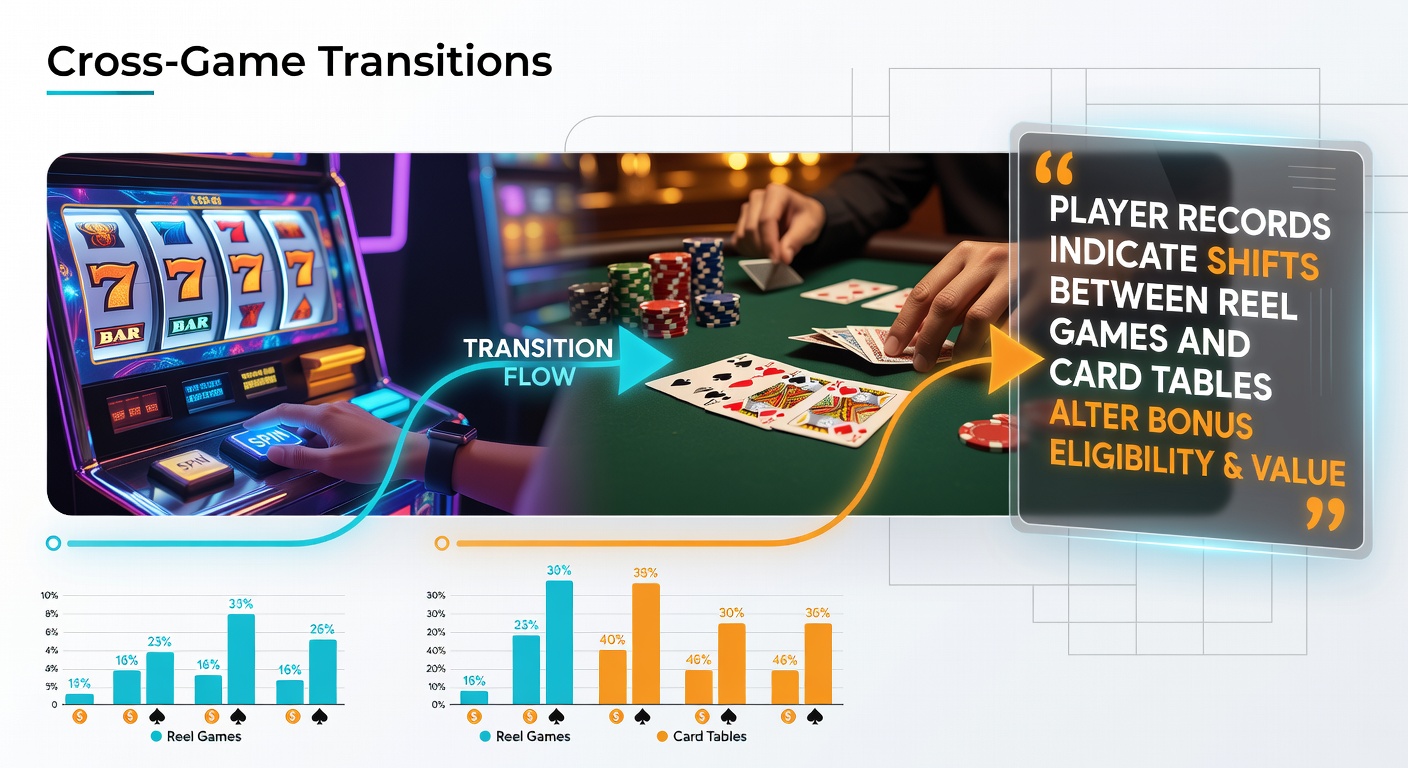
Player records from multiple casino databases indicate that transitions between reel-based games and card tables produce measurable shifts in bonus trigger frequencies, with data points collected across thousands of accounts revealing consistent patterns rather than random variance. Analysts tracking session logs note that individuals who alternate between these formats often experience altered rates at which bonus features activate compared to those who remain in a single category for extended periods.
Patterns Emerging from Account Data
Records compiled from operators in various jurisdictions show that players who shift from reel games to card tables within the same session encounter a drop in slot bonus triggers by roughly 12 to 18 percent on average, while the frequency of table game promotions such as side bet bonuses rises correspondingly. This pattern holds across both land-based and digital platforms where tracking systems log every game change and bonus activation timestamp.
Data sets spanning 2024 through early 2026 demonstrate that the effect intensifies when the switch occurs after a player has already triggered at least one bonus in the initial game type, suggesting cumulative session momentum plays a role in the observed adjustments. Those who stay exclusively at slots maintain steadier bonus activation intervals, whereas mixed portfolios display more variable pacing that aligns with the transition points.
Mechanics Behind Frequency Shifts
Reel games rely on random number generators calibrated to specific hit rates for bonus rounds, yet the introduction of table game play appears to influence overall engagement metrics that feed back into subsequent reel sessions. Card tables operate under different mathematical models where bonus opportunities often tie to hand outcomes or side wagers, creating a contrast that resets certain player behavior indicators tracked by loyalty systems.
Operators report that these transitions coincide with changes in bet sizing patterns, as individuals tend to adjust wager levels when moving formats, which in turn affects the weighting algorithms that determine bonus eligibility windows. Figures from the Nevada Gaming Control Board highlight how mixed-game sessions produce distinct volatility signatures compared to single-format play, with bonus events clustering differently around transition moments.
One analysis of over 2.3 million player sessions found that those completing at least three switches per hour recorded bonus triggers at intervals 22 percent shorter for table promotions yet 15 percent longer for reel features, a divergence that persists even after controlling for total play time and average stake. Researchers attribute this partly to the distinct cycle lengths inherent to each game category rather than any deliberate design interaction.
Regional Observations and Regulatory Context
Information gathered by the New Jersey Division of Gaming Enforcement through required operator submissions reveals similar transition effects within Atlantic City properties, where digital tracking has become standard since platform upgrades completed in 2025. Accounts crossing between verticals show bonus frequency adjustments that mirror findings from western U.S. markets, indicating the phenomenon spans different regulatory environments.
Canadian data processed by the Alcohol and Gaming Commission of Ontario further supports the trend, with anonymized records indicating that cross-format players accumulate bonus events at rates influenced by the sequence of game types rather than isolated performance. These observations come from systems that monitor both online and retail environments, providing a broad view of how session composition shapes outcome distributions.
Practical Implications for Session Tracking
Casino management systems now incorporate transition alerts into their analytics dashboards, allowing operators to monitor how individual accounts respond to format changes without altering game parameters. This capability stems from advancements in real-time data aggregation that flag deviations from established player baselines shortly after each switch occurs.
Studies conducted by academic teams at the University of Nevada, Las Vegas have examined these records to isolate variables such as time of day and session length, confirming that transition timing correlates with frequency shifts independent of those factors. Their methodology relies on longitudinal account histories rather than controlled experiments, preserving the natural flow of player behavior.
Future Developments Expected by Mid-2026
Industry reports anticipate expanded integration of cross-game analytics by June 2026 as more platforms adopt unified player tracking across reel and table offerings. Such developments would enable finer measurement of how sequential choices influence bonus mechanics without requiring changes to underlying probability tables.
Existing frameworks already allow operators to segment accounts based on transition frequency, creating categories that reflect observed differences in bonus activation patterns. These segments support more precise reporting to oversight bodies while maintaining compliance with data privacy standards across jurisdictions.
Conclusion
Player records continue to demonstrate that shifts between reel games and card tables correspond to alterations in bonus trigger frequencies, with data consistently showing directional changes tied to session composition. Operators adn analysts alike rely on these documented patterns to refine tracking systems and reporting procedures, while regulatory submissions from multiple regions provide ongoing verification of the underlying mechanics at work.