Stake Fluctuations in Extended Online Sessions: Insights Drawn from Gaming Account Records

Analysts tracking thousands of online gaming accounts have documented consistent patterns in how players adjust their wager amounts as sessions stretch beyond two or three hours, and these adjustments follow measurable trends rather than random shifts. Records collected across multiple platforms reveal that bet sizes tend to decrease gradually in the first ninety minutes before stabilizing or rising again after the three-hour mark, while data compiled through May 2026 shows this sequence repeating across different game types and player demographics.
Operators and researchers examine these variations by pulling timestamped transaction logs that capture every stake placed during a single continuous login period, and the resulting datasets allow direct comparison of early-session behavior against later phases. One large-scale review of European and North American accounts found that average bet amounts dropped by roughly 12 percent between the thirty-minute and two-hour points, then climbed back toward initial levels once play extended past four hours.
Early-Session Conservatism and Mid-Session Stabilization
Account data indicates that many players begin sessions with smaller relative stakes, often keeping wagers between 0.5 and 1 percent of their current balance during the opening thirty minutes, and this cautious approach appears across both slot and table-game categories. As time passes, the same accounts show a narrowing of the range, with most bets clustering around a narrower band once the session reaches the ninety-minute threshold.
Regulatory reports from the Australian Communications and Media Authority highlight similar stabilization patterns when reviewing licensed platform logs, noting that variance in stake size declines measurably after the initial hour. Observers note that this reduction in fluctuation coincides with players settling into a preferred betting rhythm rather than testing multiple sizes.
Late-Session Increases and Fatigue Indicators
Beyond the four-hour mark, the same datasets reveal a gradual uptick in average stake size, with some accounts showing increases of 8 to 15 percent compared with the two-hour baseline. These shifts occur even when account balances remain relatively stable, suggesting the change stems from session duration rather than bankroll pressure alone.
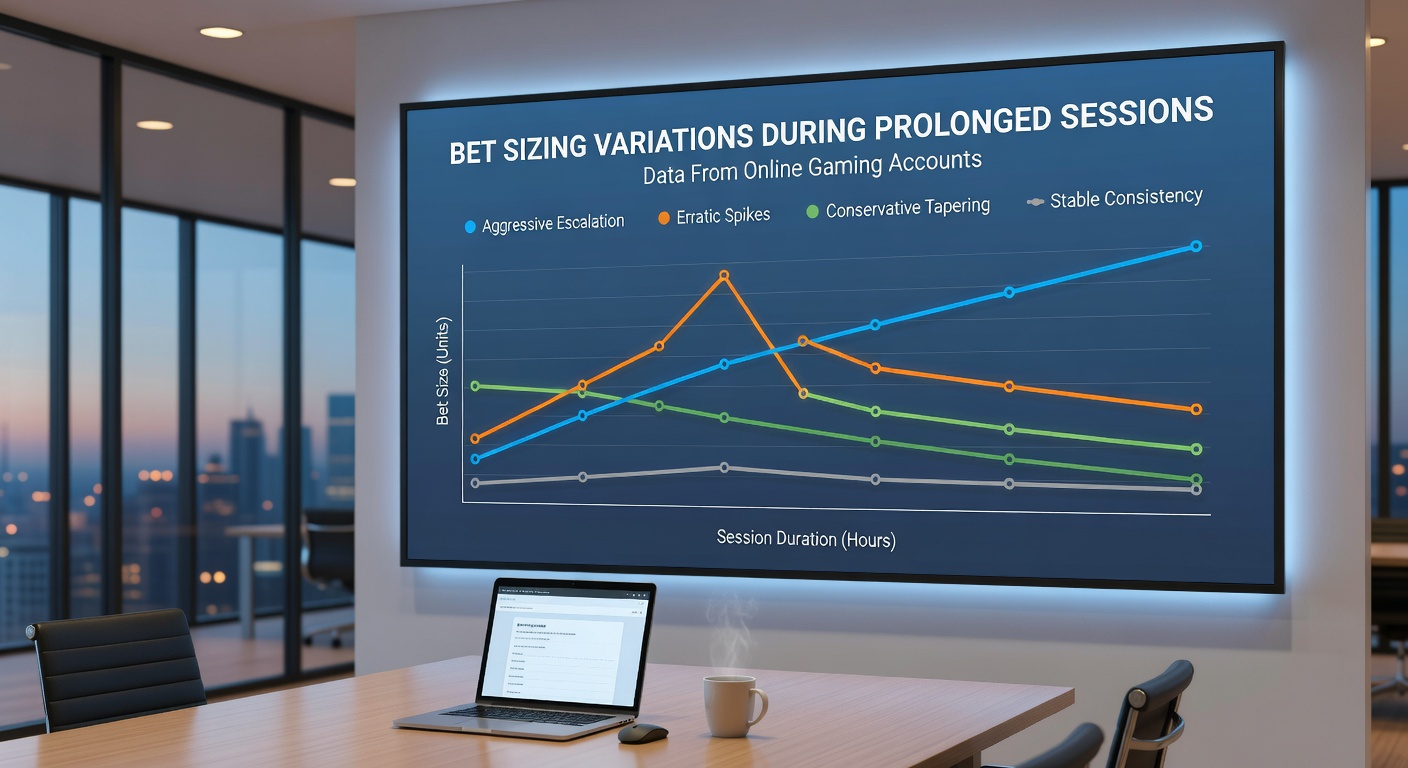
Studies published by the National Center for Responsible Gaming link these late-session increases to measurable changes in decision speed and error rates, and the pattern holds when researchers control for total amount wagered. Accounts that continued past five hours displayed the largest average jumps, while shorter sessions rarely exhibited the same upward movement.
Game-Type Differences in Adjustment Patterns
Slot-focused accounts tend to reduce bet size more sharply during the first two hours than table-game accounts, yet both categories converge toward similar late-session increases once duration exceeds four hours. Multi-game portfolios show intermediate behavior, with players switching titles while maintaining steadier stake levels across the transition points.
Canadian provincial data from iGaming Ontario confirms that mixed-portfolio users adjust stakes less dramatically than single-game specialists, and the difference becomes statistically noticeable after the three-hour mark. These findings come from anonymized transaction files that preserve session length without identifying individual users.
Factors Correlated with Stake Variation
Account-level analysis connects larger late-session adjustments to login times that begin in the evening hours, whereas morning and afternoon starts display flatter trajectories overall. Balance volatility also correlates with the size of changes, although the relationship weakens once researchers account for total session length.
Platform operators have begun incorporating these duration-based metrics into responsible-gaming tools, and preliminary deployments show users receiving prompts when their personal stake pattern deviates from their established baseline. Data from these systems continues to accumulate, providing finer resolution on how individual accounts respond to extended play.
Conclusion
Longitudinal records from online gaming accounts demonstrate that bet sizing follows predictable trajectories tied to session length, with early conservatism giving way to stabilization and eventual increases after several hours of continuous play. Regional regulators and research organizations continue to refine the granularity of these datasets, and the patterns identified through May 2026 supply a factual foundation for understanding how wager behavior evolves over time.