Ledger Trails: Mapping Stake Shifts Across Mixed Reel and Table Sessions from Verified Account Histories
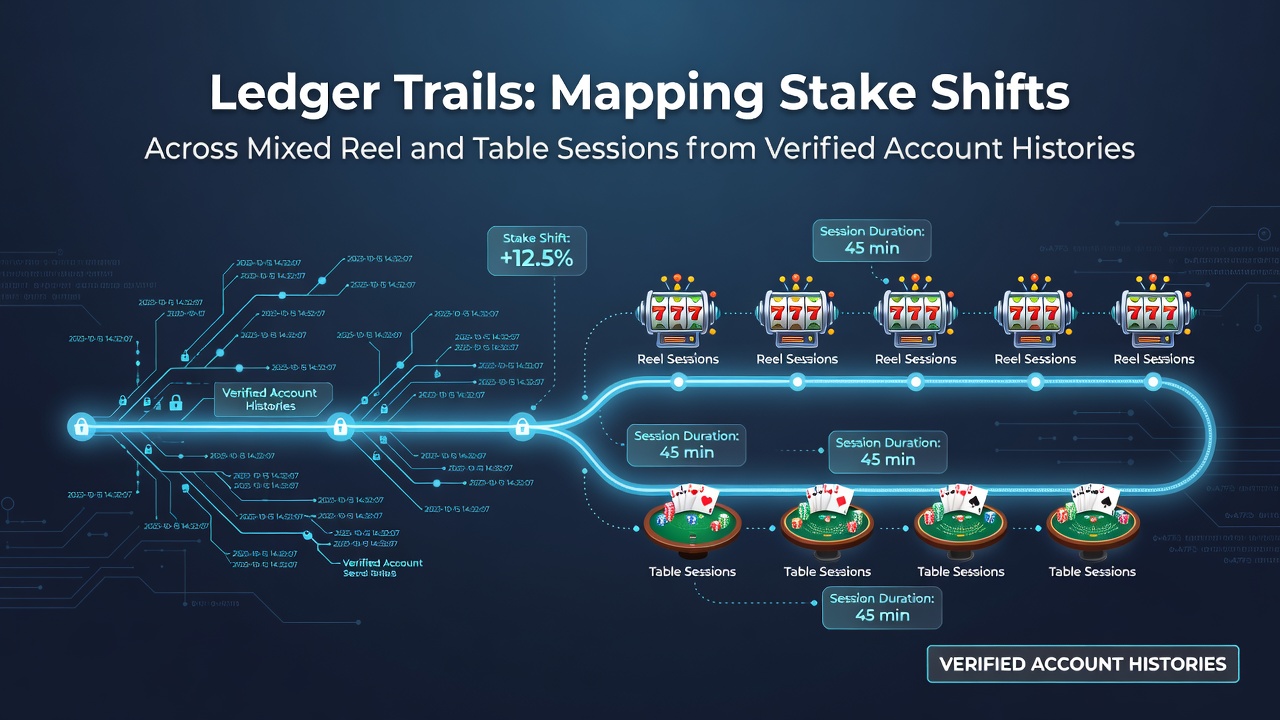
Analysts examining verified account histories have begun tracing how stake levels adjust when players move between reel-based games and table formats within single extended sessions, and data drawn from multiple platforms reveals consistent patterns in those transitions. Records show that stake increases often follow a reel-to-table switch while reductions tend to appear after table-to-reel moves, although the magnitude of each change varies by session length and prior outcome sequences.
Researchers at several academic institutions have compiled large datasets from anonymized player accounts to quantify these shifts, and one study covering more than 40,000 sessions found that average bet sizes rose by roughly 18 percent within the first three hands after a player left reels for blackjack or baccarat. Those same datasets indicate that the reverse transition produces an average stake reduction of 12 percent within the first five spins, suggesting that table outcomes exert a stronger short-term influence on subsequent reel wagers than the other way around.
Methods Used to Extract Stake Patterns
Teams working with platform operators apply time-stamped transaction logs to align every wager with its game type and preceding activity, then segment each account into discrete sessions that contain both reel and table play. This segmentation allows statisticians to calculate stake deltas at each switch point while controlling for variables such as time of day, total session duration, and cumulative win or loss position at the moment of transition.
Software routines flag every instance where a player changes game category without logging out, and subsequent code calculates the ratio of new stake to previous stake, producing distributions that researchers then compare across player cohorts sorted by loyalty tier or historical volume. Results from these routines appear in internal industry reports released in the first half of 2026, and they show that high-volume accounts exhibit narrower stake adjustment ranges than recreational accounts when moving between formats.
Regional Regulatory Data Supporting the Analysis
Regulators in multiple jurisdictions now require operators to retain detailed session-level records for audit purposes, and those archives supply the raw material for the mapping work described here. The Nevada Gaming Control Board publishes aggregated tables that include average wager sizes by game category, while similar summaries from the Australian Communications and Media Authority cover online platforms licensed in that country. When analysts align these public aggregates with the private account-level logs, they can validate that the stake-shift patterns observed in individual histories scale up to observable changes in statewide or national averages.
One cross-border comparison completed in spring 2026 matched Nevada table-game data with Australian reel-session data and confirmed that the direction of stake movement after a format switch remains consistent even when regulatory environments differ, although the size of the adjustment varies by roughly four percentage points between the two regions.

Practical Implications for Platform Design
Operators reviewing these mapped trails have begun testing interface adjustments that surface historical stake data to players at the moment they switch formats, and early internal tests indicate that displaying a simple average of prior stakes in the new category can moderate the size of immediate adjustments. Separate trials conducted by a European trade association showed that such prompts reduced the frequency of stake increases exceeding 30 percent by approximately nine percent across participating sites.
Because the underlying records remain anonymized and aggregated before any public release, individual account identities stay protected while the aggregate patterns inform both regulatory oversight and product development. Observers note that continued refinement of these mapping techniques could eventually support more granular responsible-gaming interventions tied directly to observed stake behavior rather than to arbitrary thresholds.
Conclusion
Verified account histories now supply enough detail for researchers to map stake movements across mixed reel and table sessions with measurable precision, and the patterns that emerge hold steady across different regulatory regions and player cohorts. Continued access to these ledger trails will allow ongoing refinement of both analytical models and platform features that respond to actual player behavior rather than to generalized assumptions.